 New Orleans Ghost Tours
Lafayette Cemetery No. 1: The Garden District Cemetery and How to Visit
Lafayette Cemetery No. 1 is the Garden District cemetery with about 1,100 family tombs on a single city block. It closed in 2019 and reopened in 2026 for guided tours only, run by Save Our Cemeteries at the Preservation Resource Center. This guide covers the closure and the reopening, the history from 1833, the yellow fever burials, the films and Anne Rice, and how to reach the gates. It is honest about one thing from the start: none of the ghost tours compared on this site walks inside Lafayette Cemetery No. 1. If you want a cemetery at night, the bus tours are the honest option, and this page explains why. For how the cemetery visits compare across the city, see the guide to New Orleans cemetery tours. The bookable tours are compared on New Orleans ghost tour.
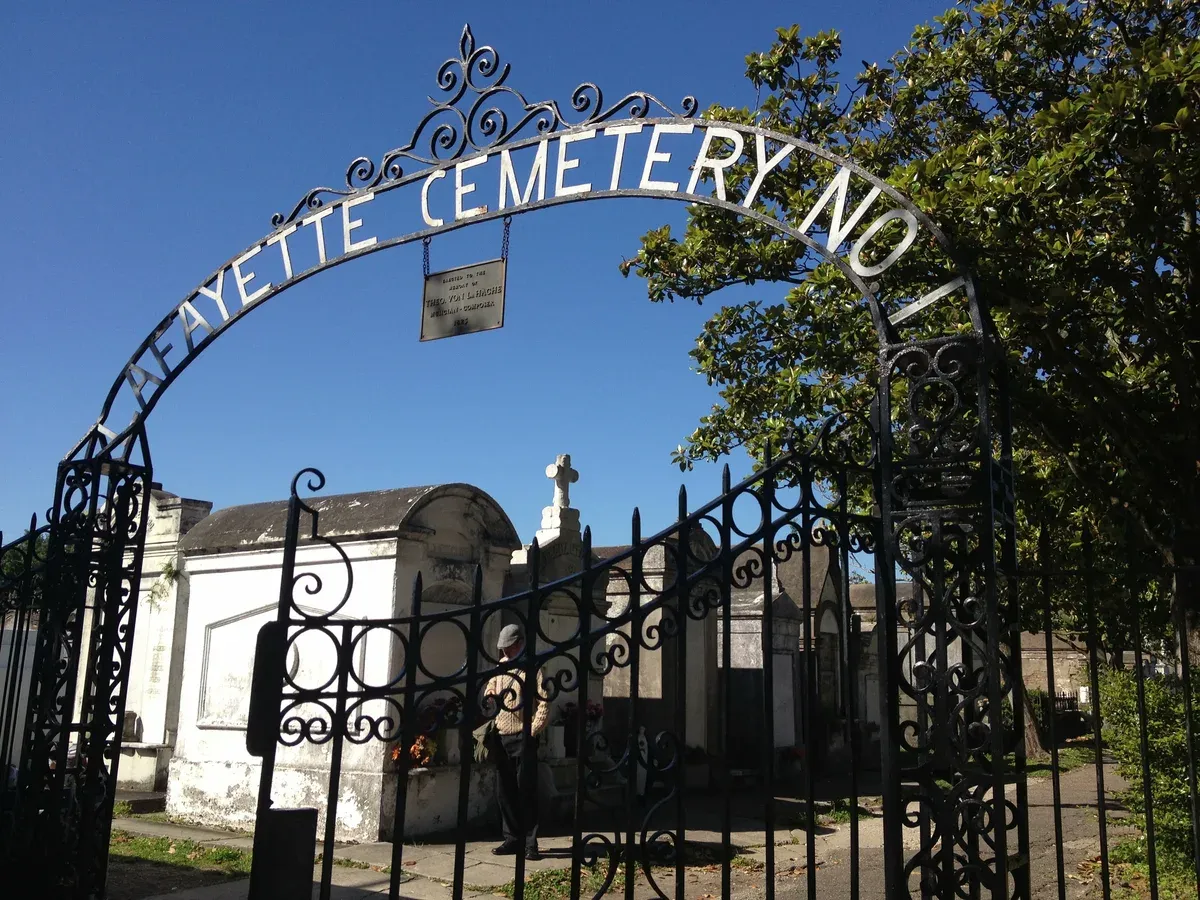
The Lafayette Cemetery No. 1 gate, with tombs beyond. Photo: President Rhapsody, CC BY-SA 3.0, via Wikimedia Commons
Quick answer Is Lafayette Cemetery No. 1 open?
Yes. Lafayette Cemetery No. 1 reopened for guided tours in 2026 after a seven-year closure, founded in 1833 and holding about 1,100 tombs. Entry is by guided tour only, with groups of 16 or fewer. Solo visiting is not allowed, so check times and book on the Preservation Resource Center site before you go. No ghost tour on this site goes inside it.
Key takeaways
- The cemetery closed in 2019 over vandalism, restoration needs and crowding from large tour groups, and reopened for guided tours only in 2026.
- Save Our Cemeteries at the Preservation Resource Center runs the tours, with groups of 16 or fewer.
- Want a cemetery after dark? The Cemetery and Ghost BYOB Bus Tour rides to graveyards at night, though it does not enter Lafayette No. 1.
- If your aim is the oldest cemetery and Marie Laveau's tomb, that is St. Louis Cemetery No. 1, a different cemetery with its own rules.
Is Lafayette Cemetery No. 1 Open?
The short answer is yes, but only with a guide. Here is what changed and how the visits work now.
The 2019 Closure and Why It Happened
Lafayette Cemetery No. 1 closed in 2019. Three reasons were given: vandalism, restoration needs and crowding from large tour groups. On a block holding about 1,100 family tombs and around 7,000 interments, the wear showed. The cemetery is one of six municipal cemeteries the city runs, alongside Lafayette No. 2, Carrollton No. 1 and No. 2, Valence and Holt, and it sat closed for seven years.
The World Monuments Fund had already flagged the cemetery twice, putting it on its Watch list in 1996 and again in 2006 after Hurricane Katrina. The closure was less a surprise than a long-arriving reckoning. If you read older guidebooks that list visiting hours of 7 a.m. to 2:30 p.m. on weekdays, throw that page away. Those hours died with the closure.
- Closed: 2019
- Reasons: vandalism, restoration needs, crowding from large tour groups
- Length of closure: seven years
- Watch list placements: 1996 and 2006
The Reopening for Guided Tours Only
The cemetery reopened on 1 October 2026, for the first time in seven years, and the reopening came with a hard rule: guided tours only. No walk-ins, no solo wandering, no showing up with a coffee and a camera. The closure years were used for walkway improvements, better maintenance and preservation work on the historic structures. An 1866 society tomb with 20 vaults was restored and is now available for burials again, which tells you this is a working cemetery, not just a film set.
One more thing worth knowing. Accommodation is made for visitors who have loved ones buried there, so families with graves in the cemetery are not treated the same as tourists. That is a decent policy and worth respecting.
- Reopened: 1 October 2026
- Access: guided tours only
- Restored during closure: walkways, maintenance, an 1866 society tomb with 20 vaults
Who Runs the Tours and How to Book
Save Our Cemeteries at the Preservation Resource Center runs the Lafayette Cemetery tours. This is a preservation organisation, not a ghost outfit. Booking is on the Preservation Resource Center site at prcno.org/cemetery-tour/lafayette-cemetery-no-1/.
Groups are 16 people or fewer, which is a far cry from the crowds that helped force the closure. Check the Preservation Resource Center page for the current price and times before you book.
- Operator: Save Our Cemeteries at the Preservation Resource Center
- Group size: 16 or fewer
- Booking: prcno.org/cemetery-tour/lafayette-cemetery-no-1/
- Price and times: confirm on the booking page
Can You Visit Without a Tour?
No. Since the reopening, entry is by guided tour only, and groups of 16 or fewer are the whole picture. There is no general admission window and no published self-guided visiting hours, so any old listing of weekday and Saturday hours predates the 2019 closure and no longer applies.
The one exception is for people with loved ones buried in the cemetery, for whom accommodation is made. Everyone else books a tour. If you want to compare this against the other cities of the dead, including the Archdiocese-run St. Louis No. 1 where entry has been guide-only since 2015, see the comparison of cemetery tours. For the cemetery most people mean when they say the famous one, read the guide to St. Louis Cemetery No. 1.
Getting There: Gates and the Streetcar
The cemetery sits at 1403 Washington Avenue in the Garden District, across the street from Commander's Palace. It has entrances on Washington Avenue and 6th Street. The easiest ride in is the St. Charles streetcar, which is worth the trip on its own. The line opened in 1835 and is the oldest continuously operating streetcar line in the world, made a National Historic Landmark in 2014. It runs 6.6 miles from Carrollton and Claiborne avenues to Canal Street over 61 stops, 24 hours a day, with daytime cars about every 9 minutes. Most cars are 900 series cars built in 1923 and 1924.
Ride it from Canal Street through the Central City blocks and get off in the Garden District. Check the RTA site for the fare and the nearest stop before you ride. Pair the cemetery with lunch nearby. Emile Commander opened a saloon at Washington Avenue and Coliseum Street in 1893, and the Brennan family bought the restaurant in 1969.
- Address: 1403 Washington Avenue, Garden District
- Gates: Washington Avenue and 6th Street
- Transit: St. Charles streetcar, 24 hours a day, cars about every 9 minutes in daytime
What About Ghost Tours of Lafayette?
Here is the honest line this site keeps repeating: none of the ghost tours compared on this site goes inside Lafayette Cemetery No. 1. The night bus tours ride to actual graveyards after dark, and those are the Cemetery and Ghost BYOB Bus Tour at $30 for up to 56 people over 2 hours, departing from Decatur Street, and the Dead of Night bus tour at $45 over 2 hours from North Rampart Street. Neither lists Lafayette No. 1 as a stop, and no tour listing states entry to it. If a walking tour ever sells you Lafayette Cemetery at night, ask exactly where it goes before you pay, because the gates are closed to everyone but Save Our Cemeteries groups.
What night buses do deliver is atmosphere at scale, and they are the closest thing to a cemetery after dark that you can book right now. Daytime history inside Lafayette is a separate booking with the Preservation Resource Center.
- Ghost tours entering Lafayette No. 1: none on this site
- Cemetery and Ghost BYOB Bus Tour: $30, 2 hours, up to 56 people
- Dead of Night Ghosts and Cemetery Bus Tour: $45, 2 hours
Sources: WLOX, City of New Orleans Division of Cemeteries, Free Tours by Foot, Afar
History of Lafayette Cemetery No. 1
One city block, about 1,100 tombs, roughly 7,000 people, and a story that runs from the city of Lafayette through yellow fever, the Civil War and Hollywood.
A Timeline of the Cemetery
The cemetery was founded in 1833 in what was then the city of Lafayette, before that area was annexed to New Orleans in 1852. It was designed by Benjamin Buisson in a Neo-Classical style, and its interior lanes were laid out to accommodate funeral processions, which is why the block reads so formally today. It is often called the first planned cemetery in New Orleans.
The table gives the dated events in one glance.
| Year | What happened |
|---|---|
| 1832 | The Garden District was subdivided from the Livaudais Plantation and laid out by Barthelemy Lafon |
| 1833 | Lafayette Cemetery No. 1 was founded in the city of Lafayette |
| 1852 | The city of Lafayette was annexed to New Orleans |
| 1853 | The yellow fever epidemic filled the tombs, with 8,647 deaths across Louisiana |
| 1866 | A society tomb with 20 vaults was built, restored and reopened for burials after the closure |
| 1994 | Interview with the Vampire was filmed in the cemetery |
| 1995 | Anne Rice staged a coffin stunt here to promote Memnoch the Devil |
| 1996 | The World Monuments Fund put the cemetery on its Watch list |
| 2006 | The Watch list placement was renewed after Hurricane Katrina |
| 2019 | The cemetery closed over vandalism, restoration needs and tour crowding |
| 2026 | It reopened on 1 October for guided tours only |
The Tombs and the People Buried There
About 1,100 family tombs hold around 7,000 people on a single city block. The tombs are above ground because the high water table from the Mississippi, Lake Borgne and Lake Pontchartrain made in-ground burial unreliable. Oven tombs and family tombs were the norm by the 1820s, and a tomb cannot be reopened for at least a year and a day, with earlier remains moved to a receiving vault at the bottom to make room. Alongside the family tombs stand society tombs for firefighters and fraternal organisations. The names on the tombs are mostly German and Irish, because the cemetery was built to serve the Americans and immigrants who arrived after the Louisiana Purchase.
Among the buried is Judge John Howard Ferguson, the judge in Plessy v. Ferguson, the 1896 case that upheld segregation. Also here is Confederate general Harry T. Hays, who lived from 1820 to 1876, commanded the Louisiana Tigers brigade and served briefly as sheriff of Orleans Parish after the Civil War before dying of Bright's disease. A graveyard is rarely quieter than its history, and this block carries some of the loudest.
- Tombs: about 1,100 family tombs plus society tombs for firefighters and fraternal groups
- Interments: around 7,000 on one city block
- Notable burials: Judge John Howard Ferguson, General Harry T. Hays
- Why above ground: the high water table made in-ground burial unreliable
Yellow Fever and the Names in the Lanes
The 1853 yellow fever epidemic hit the city hard. Louisiana recorded 8,647 deaths that year, one count puts New Orleans alone at 7,048 documented deaths and other accounts say 10,000 or more, so historians generally speak of more than 8,000 dead in the city that summer. On a single day in August 1853, 230 deaths were reported. One in five Irish immigrants in the city died that summer. The cause remained a mystery at the time. Open wooden cisterns were perfect mosquito breeding grounds, but the mosquito link was not confirmed until Walter Reed's commission proved it in 1900. The last U.S. outbreak hit New Orleans in 1905 and killed 452 people.
This is the documented history a guide will give you inside the gates, and it needs no ghosts to be grim. The epidemics are also the backdrop to the New Orleans ghost tour, where guides retell the fever years.
- 1853: 8,647 deaths in Louisiana, 230 on the worst single day
- One in five Irish immigrants in the city died that summer
- Mosquito transmission confirmed in 1900, last U.S. outbreak in 1905 with 452 deaths
Anne Rice, the Films and Why the Cemetery Is Famous
Anne Rice did more than any writer to make this block famous. She grew up at 2301 St. Charles Avenue and later at 2524 St. Charles Avenue, and after returning to New Orleans in 1988 she and her husband Stan bought the 1857 Brevard-Rice House at 1239 First Street in the Garden District. Interview with the Vampire was published in 1976, and the 1994 film with Tom Cruise and Brad Pitt shot scenes in Lafayette Cemetery No. 1. In 1995 Rice staged a coffin stunt in the cemetery to promote her novel Memnoch the Devil. She announced in 2004 that she would leave New Orleans and moved to Kenner. She died in 2021 and was interred at Metairie Cemetery in 2022 with her husband and daughter Michele. Her grave is not here, but fans still come to the block that made her vampires feel at home.
Hollywood kept coming. Double Jeopardy was also filmed in the cemetery, and AMC's Interview with the Vampire series used the neighbourhood. Add the Buckner Mansion nearby, which served as the exterior of Miss Robichaux's Academy in Coven, and the Garden District is a working backlot.
- Films shot here: Interview with the Vampire (1994), Double Jeopardy, plus AMC's Interview with the Vampire series nearby
- Anne Rice grew up on St. Charles Avenue and lived at the Brevard-Rice House on First Street
- She is buried at Metairie Cemetery, not Lafayette No. 1
Sources: Wikipedia: Lafayette Cemetery No. 1, 64 Parishes: Yellow Fever, Preservation Resource Center, Cemetery Travel
Lafayette Cemetery No. 1 Is Reopening. Here's What's Changing
A local news report on the cemetery's reopening and the new rules. Third-party video by WWLTV. This site did not shoot it and has no relationship with the creator.
Getting There: Streetcar, Gates and Hours
Lafayette Cemetery No. 1 sits at 1403 Washington Avenue in the Garden District, across the street from Commander's Palace. Here is how to reach it and when you can get in.
Take the St. Charles Streetcar
The St. Charles streetcar is the classic way in. The line opened on 26 September 1835, which makes it the oldest continuously operating streetcar line in the world, and it became a National Historic Landmark in 2014. It runs 6.6 miles from Carrollton and Claiborne avenues to Canal Street with 61 stops, 24 hours a day, with daytime cars about every 9 minutes. Most of the cars are 900 series vehicles built in 1923 and 1924, so the ride is part of the experience. Full service to Carrollton was restored in June 2008 after Hurricane Katrina.
Ride to a Washington Avenue stop and walk to the cemetery. Check the RTA site for the fare before you travel. The cemetery sits across the street from Commander's Palace at 1403 Washington Avenue, so the restaurant is a simple landmark once you are off the car.
The Two Gates: Washington Avenue and 6th Street
Lafayette Cemetery No. 1 has entrances on Washington Avenue and on 6th Street. Since the cemetery reopened for guided tours, entry works differently from most city parks. Visitors join a tour run by Save Our Cemeteries at the Preservation Resource Center, which limits groups to 16 or fewer. Booking is on the Preservation Resource Center site at prcno.org/cemetery-tour/lafayette-cemetery-no-1/, and you should confirm the current schedule and any price there before you go, because the reopening arrangements are new.
If you have a loved one buried in the cemetery, the operator makes accommodation for you, so contact them directly rather than assuming the tour-only rule blocks family visits. There is no indication in the sources of walk-up entry without a guide, and the old opening hours posted before the 2019 closure no longer apply.
Hours of the City Cemeteries
Lafayette No. 1 is one of six municipal cemeteries run by the city, alongside Lafayette No. 2, Carrollton No. 1 and No. 2, Valence and Holt. For the others, the city states that most open cemeteries are open weekdays 8 a.m. to 2 p.m. and Saturdays 8:30 a.m. to 3 p.m., and closed on Sundays. Those are general city cemetery hours, not Lafayette No. 1 hours. Lafayette No. 1 is guided tours only, so there is no free-entry window to plan around.
The practical takeaway is simple. Book ahead on the Preservation Resource Center page, arrive at the Washington Avenue or 6th Street gate a few minutes before your tour, and budget the rest of the day for the Garden District. For other cemeteries, St. Louis Cemetery No. 2 was founded in 1823 and No. 3 in 1854, and the page on New Orleans cemetery tours compares which operators get you inside which grounds. Also note that Commander's Palace across the street was founded in 1880, reopened after Hurricane Katrina on 1 October 2006, and entered the Culinary Institute of America Hall of Fame in 2008, so lunch can anchor the trip.
Sources: WLOX, City of New Orleans Division of Cemeteries, St. Charles Streetcar Line, Afar, Commander's Palace
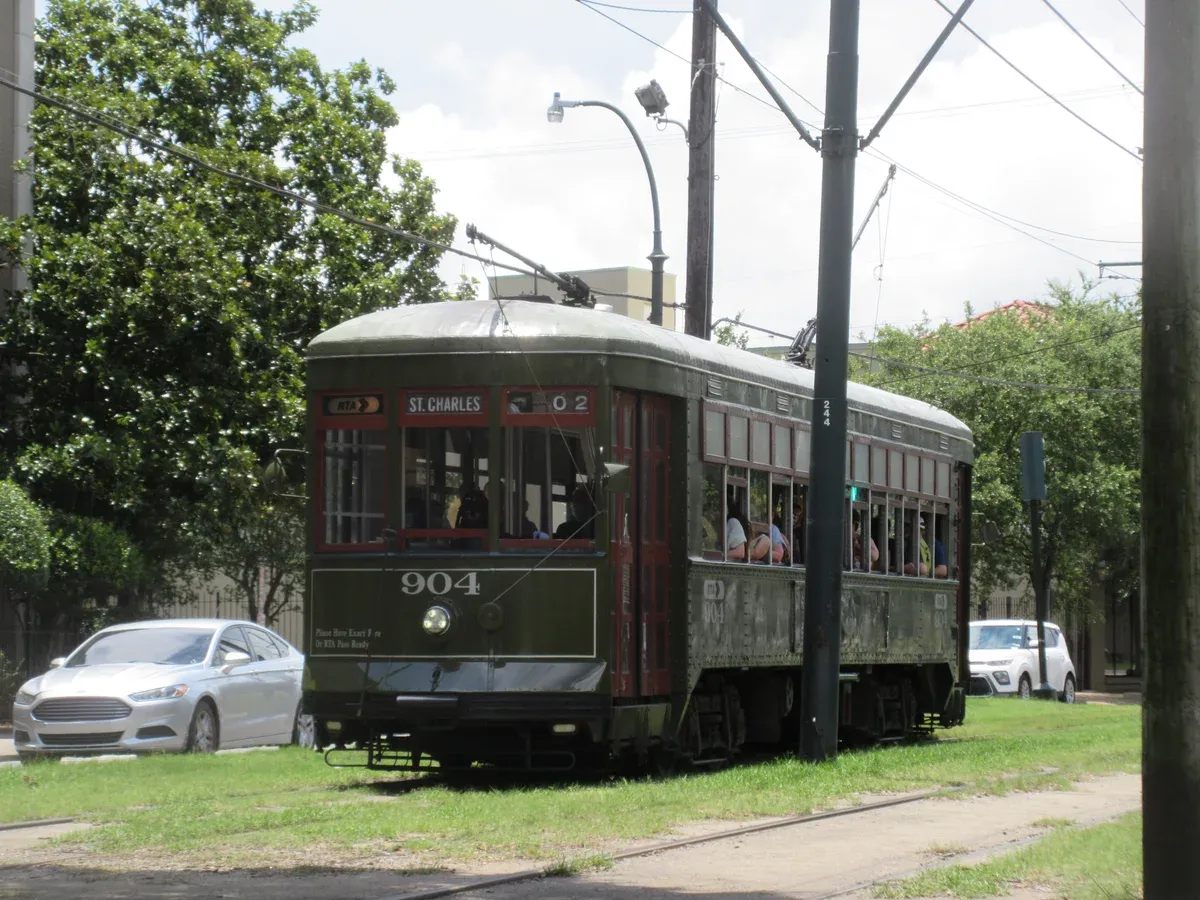
A St. Charles Avenue streetcar, the line that runs past the Garden District. Photo: Infrogmation of New Orleans, CC BY-SA 4.0, via Wikimedia Commons
Anne Rice, Films and the Garden District
Lafayette Cemetery No. 1 appears in films and is tied to the writer who made New Orleans vampires famous. Both stories continue in the streets around it.
The Coffin Stunt of 1995
Anne Rice staged a coffin stunt at Lafayette Cemetery No. 1 to promote Memnoch the Devil in 1995. By then she was already the dominant literary voice of the city's dark side. Rice was born in New Orleans on 4 October 1941, Interview with the Vampire was published in 1976, and the film with Tom Cruise and Brad Pitt came out in 1994. The 1995 stunt fixed the link between the cemetery and her work in the public mind.
Rice's own New Orleans story runs through the Garden District. She grew up at 2301 St. Charles Avenue and later 2524 St. Charles Avenue. After returning to the city in 1988, the Rices bought the 1857 Brevard-Rice House at 1239 First Street, a private home you can see from the street. She announced on 18 January 2004 that she would leave New Orleans and moved to a gated community in Kenner. Rice died on 11 December 2021 and was interred at Metairie Cemetery in January 2022 with her husband Stan and daughter Michele, so her grave is in Metairie, not in Lafayette No. 1.
The Movies Shot Between the Tombs
Interview with the Vampire (1994) was filmed in Lafayette Cemetery No. 1. Double Jeopardy was shot there too. Afar calls Lafayette No. 1 the first planned cemetery in New Orleans, designed by Benjamin Buisson in a Neo-Classical style, and its interior lanes were laid out to accommodate funeral processions, which is part of why it reads so well on camera. AMC's Interview with the Vampire series also used the neighbourhood as well.
A few streets away, the Buckner Mansion in the Garden District served as the exterior of Miss Robichaux's Academy in American Horror Story: Coven. Like the Brevard-Rice House and Colonel Short's Villa at 1448 Fourth Street with its cornstalk iron fence, the Buckner Mansion is a private home visible only from the street. That is the rule for the whole district: photograph the facades from the sidewalk and keep moving. The page on haunted places in New Orleans lists more exteriors worth a detour.
The Garden District Around the Gates
The cemetery was founded in 1833 in what was then the city of Lafayette, and the district around it was subdivided in 1832 from the Livaudais Plantation and laid out by Barthelemy Lafon. Development ran from 1832 to 1900 as wealthy Americans built estates away from the Creole residents of the older city, and the area became part of the city of Lafayette in 1833 before being annexed to New Orleans in 1852. It was named a National Historic Landmark district in 1974.
The boundaries are St. Charles Avenue, 1st Street, Magazine Street and Toledano Street, so the cemetery sits inside them near the northern edge. Early 19th-century mansions mix with late Victorian houses, and the district's higher ground kept it from major flooding in Hurricane Katrina, when about 80 percent of New Orleans flooded. Commander's Palace on the corner of Washington Avenue and Coliseum Street opened as Emile Commander's saloon in 1893 and the Brennan family bought the restaurant in 1969.
Sources: Wikipedia on Lafayette Cemetery No. 1, Anne Rice, Garden District, Afar
Cemeteries After Dark: What the Tours Actually Do
You cannot wander Lafayette Cemetery No. 1 at night, and none of the ghost tours on this site goes inside it. Here is what the night options actually deliver.
Why Night Readers End Up on a Bus
Lafayette Cemetery No. 1 reopened for guided tours on 1 October 2026 after a seven-year closure, and the reopening terms are strict. Entry is by guided tour only, run by Save Our Cemeteries at the Preservation Resource Center, with groups of 16 or fewer. Those are daytime history sessions, not ghost walks, and no operator on this site holds a slot inside the gates. Confirm the price and times on the Preservation Resource Center page.
If you want graves after dark, the realistic options are the cemetery bus tours, which ride to graveyards at night with a guide. St. Louis Cemetery No. 1 has its own official walking tour at $25, run by Basin St. Station with a 55-minute route past the tombs of Marie Laveau and Homer Plessy, and it can be booked as an after-dark option. Entry to St. Louis No. 1 has been limited since 1 March 2015 to relatives of the dead, scholars and visitors with a registered guide, so independent night visits are off the table there too. For a fuller breakdown of who enters which ground, see the page comparing New Orleans cemetery tours. The table lists only what each listing states.
The Night Cemetery Tours Compared
Several listings on this site put you near graves or inside a cemetery, and the figures here come straight from their listings. The first bus departs N Rampart Street and asks you to arrive 20 minutes before departure. The BYOB bus checks in at a Decatur Street tavern 30 minutes before tour time and carries up to 56 guests.
The official St. Louis No. 1 walk includes cemetery access through the guided tour with a pass issued at check-in. Start times show when you check availability on the booking page.
| Tour | Price | Length | Cemeteries |
|---|---|---|---|
| Dead of Night Ghosts and Cemetery Bus Tour | $45 | 2 hours | Night bus ride to haunted locations and the cities of the dead, no stop list given |
| Cemetery and Ghost BYOB Bus Tour | $30 | 2 hours | Bus ride to actual graveyards after dark, no stop list given |
| St. Louis Cemetery No. 1 Official Walking Tour | $25 | 55 minutes | Inside St. Louis No. 1 with cemetery access included, past the tombs of Marie Laveau and Homer Plessy |
Sources: WLOX, NPR, neworleans.com
Lafayette Cemetery No. 1: Your Questions
Is Lafayette Cemetery No. 1 open?
Yes, for guided tours only. It reopened on 1 October 2026 after closing in 2019, and Save Our Cemeteries at the Preservation Resource Center runs the visits in groups of 16 or fewer. The details are in Is Lafayette Cemetery No. 1 Open?.
Can you walk into Lafayette Cemetery No. 1 on your own?
No. Since the reopening the gates open for guided tours only, so book through the Preservation Resource Center and confirm the price and times there. St. Louis Cemetery No. 1 works the same way, with entry only on a registered tour.
Why did Lafayette Cemetery No. 1 close?
It closed in 2019 over vandalism, the need for restoration and crowding from large tour groups. The history section covers the cemetery from its founding in 1833.
How do you get to Lafayette Cemetery No. 1?
Take the St. Charles streetcar into the Garden District. The gates are on Washington Avenue and 6th Street, as set out in Getting There.
Is Lafayette Cemetery No. 1 on a ghost tour?
None of the tours on this site goes inside it. The night bus tours visit cemeteries after dark without naming them, and the official St. Louis Cemetery No. 1 walk at $25 is the listing here that takes you into a cemetery.
What is the Anne Rice connection?
Anne Rice staged a coffin stunt at the cemetery in 1995, and her Garden District house at 1239 First Street can be seen from the street. More in Anne Rice, Films and the Garden District.