 New Orleans Ghost Tours
Marie Laveau Tomb: Where the Voodoo Queen Is Buried and How to See It
The Marie Laveau tomb is one of the best known graves in New Orleans and the reason many people book a cemetery tour. Marie Laveau, the city's famous Voodoo queen, rests in a family crypt in St. Louis Cemetery No. 1, and since 2015 you can only stand in front of it with a registered guide. This page covers her life, her death, the tomb itself and the legends around it, including the three X tradition and the pink paint episode of 2013. It also explains who was really buried in the crypt, because the records are less certain than the guidebooks suggest. For the cemetery as a whole, its history and its other famous graves, see the guide to St. Louis Cemetery No. 1. The bookable tours are compared on New Orleans ghost tours.
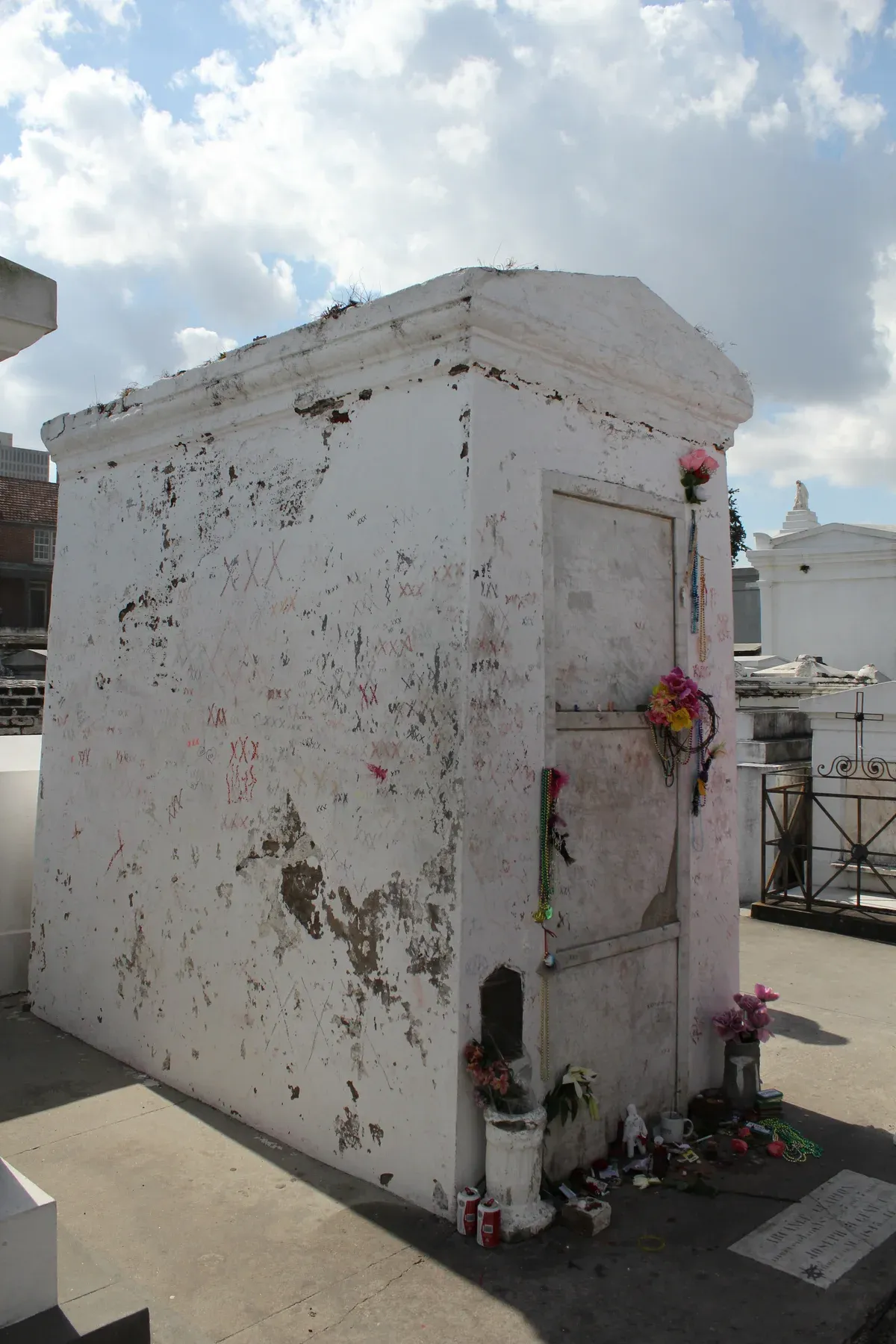
The Glapion family tomb attributed to Marie Laveau, with offerings left by visitors. Photo: Dan Soto, CC BY-SA 3.0, via Wikimedia Commons
Quick answer Where is Marie Laveau buried?
Marie Laveau, who died in 1881, is traditionally held to be buried in the Glapion family tomb in St. Louis Cemetery No. 1, and you can see the tomb only on a guided tour such as the $25 official walking tour. She is generally believed to rest in the middle vault of the family crypt, plot 347 of the cemetery on Basin Street. Since 1 March 2015 entry has been limited to relatives, scholars and visitors with a guide registered with the Archdiocese. No solo visiting is allowed, so book a walk like the St. Louis Cemetery No. 1 Official Walking Tour.
Key takeaways
- See the tomb on the St. Louis Cemetery No. 1 Official Walking Tour, a 55 minute guided walk past the Laveau and Plessy tombs.
- The cemetery's history, other graves and rules are on the St. Louis Cemetery No. 1 page.
- The Voodoo walking tour from the Historic Voodoo Museum costs $36 and passes Marie Laveau's house.
- Ghost walks in the French Quarter, such as this ghost, Voodoo and vampire walking tour, pass the New Orleans Historic Voodoo Museum.
Who Was Marie Laveau
Marie Laveau was a free woman of color who became the most famous Voodoo practitioner in New Orleans. Her life is well documented, though the legend has grown far larger than the record.
A Life in Dates
These dates come from the historical record, chiefly parish records and newspaper notices. Use them to separate the woman from the myth. Note the partnership with Christophe Glapion in particular, because the family tomb that now carries her name is the Glapion crypt.
| Year | Event |
|---|---|
| 1801 | Born on 10 September in New Orleans to Charles Laveau and Marguerite Henry |
| 1819 | Married Jacques Paris on 4 August |
| 1823 | Jacques Paris died and she became the Widow Paris |
| 1827 | Daughter Marie Heloise born, one of two children with Glapion to reach adulthood |
| 1830s | Led a multiracial religious community with weekly ceremonies at her home |
| 1855 | Her partner Christophe Glapion died |
| 1874 | Her Lake Pontchartrain ritual drew about 12,000 people |
| 1881 | Died on 15 June at her home on St. Ann Street |
Her Work and Standing
Marie Laveau worked as a hairdresser, herbalist, midwife and Voodoo practitioner. She was called the Priestess of the Voudous. By the 1830s she led a multiracial religious community and held weekly ceremonies at her own house.
She was also a churchgoer. Records show she attended Catholic Mass regularly while leading Voodoo ceremonies, which is less a contradiction than a picture of how Louisiana Voodoo actually worked. The religion blends West and Central African practice, Haitian Vodou and Catholicism, and Laveau lived inside all three.
When she died in 1881, the Daily Picayune announced that she had passed peacefully at home, and the funeral was lavish, with a mixed audience that included white elites. Major papers including The New York Times described her as a woman of beauty, intellect and charisma who was pious, charitable and a skilled herbal healer. Death notices said she nursed the sick, provided for those in need and ministered to prisoners.
Her personal story was harder. Baptismal records list seven children, and only two survived to adulthood, Marie Heloise born in 1827 and Marie Philomene born in 1836. Her two daughters with Jacques Paris, Felicite and Marie Angelie, both died in childhood. Records also confirm she owned at least seven enslaved people during her lifetime, a fact the legend often leaves out.
One more gap worth knowing before a tour: no verified contemporary portrait or photograph of Marie Laveau exists. Paintings attributed to her are unidentified portraits of free women of color, so any image your guide shows you is a guess.
The Birth Year Myth
Popular sources often give 1794 as her birth year. The records support 10 September 1801 instead. Laveau died on 15 June 1881.
If a guide gives 1794, the records say 1801.
Another legend that cannot be substantiated: whether she kept a snake named Zombi. It cannot be substantiated. The same caution applies to claims that she was buried in St. Louis Cemetery No. 2 at the so-called Wishing Vault. That claim comes from Louisiana Writers' Project interviews and no photograph or burial record supports it, so treat it as a disputed claim if a guide raises it.
Sources: Wikipedia, 64 Parishes
Voodoo in New Orleans
You cannot understand the Marie Laveau tomb without understanding the religion she led. Louisiana Voodoo grew from the forced migration of African people and survived a century of suppression.
Congo Square and the 1817 Ordinance
The first enslaved Africans reached Louisiana in 1719, and the main groups were the Bambara and the Bakongo. They carried religious practice with them, and the city gave that practice one legal outlet. A mayor's ordinance in 1817 confined gatherings of enslaved Africans to Congo Square, which sits inside Louis Armstrong Park in Tremé and covers 2.7 acres.
On Sundays the square filled. Visitors recorded 500 to 600 people dancing and drumming there on a single Sunday. Those gatherings kept drumming rhythms, dance and communal worship alive in public view, and they fed directly into the Voodoo that Laveau later led. The square joined the National Register of Historic Places in 1993, and the Congo Square Preservation Society still holds a drum circle there every Sunday.
Refugees from the Haitian Revolution arrived in the early 1800s and strengthened the Haitian Vodou influence. By the 1830s the religion had a public face, and that face was Marie Laveau.
The Gris-Gris Case of 1773
Fear of the religion is as old as the religion itself in Louisiana. The only recorded colonial prosecution tied to Voodoo was the 1773 Gris-Gris Case, decades before Laveau was born. A gris-gris is a charm for healing or cursing, ranging from material wrapped in red flannel and worn at the neck to more elaborate objects. The case shows how early and how seriously authorities treated the practice as a threat.
That fear shaped the next century. After the 1817 ordinance pushed gatherings into Congo Square, police crackdowns intensified in the 1850s and 1860s.
The 1850 Arrests
Suppression peaked in the middle of the century. In June 1850 police arrested 17 women for dancing ceremonies, among them the priestess Betsey Toledano. The crackdowns intensified through the 1850s and 1860s, and by the early 20th century organised Voodoo practice in New Orleans had been largely driven out of public life.
Laveau worked through these years anyway, and her 1874 ritual at Lake Pontchartrain drew about 12,000 Black and white New Orleanians. That scale explains both her fame and the pressure she attracted. Large St. John's Eve gatherings at the lake declined in the 1870s under tighter suppression, in her final decade.
St. John's Eve
The religion's most famous date is St. John's Eve, which falls on 23 to 24 June. By the late 1800s large celebrations were held on the shore of Lake Pontchartrain, with bonfires, drumming, singing, dancing, ritual bathing and a communal feast. Laveau led these gatherings, and her daughter Marie Laveau II, who lived from 1827 to about 1862, held even more theatrical public events, including St. John's Eve rituals on Bayou St. John.
The tradition never fully died. The Magnolia Bridge over Bayou St. John is still used for rituals every St. John's Eve, and the Voodoo Spiritual Temple was founded in 1990. If you want the living religion rather than the legend, the Historic Voodoo Museum at 724 Dumaine Street, open daily from 10 AM, and its $36 walking tour are the closest a visitor gets.
For the tomb this all explains the pull. A woman who could draw 12,000 people to a lakeshore ritual was never going to get a quiet grave.
Sources: Louisiana Voodoo, Congo Square, 64 Parishes
Marie Laveau: Tricentennial Moments
A short public television history of Marie Laveau. Third-party video by WYES. This site did not shoot it and has no relationship with the creator.
The Tomb: The Glapion Family Crypt
The tomb people call Marie Laveau's stands in St. Louis Cemetery No. 1, and its story involves a family crypt, a chalk ritual, a bucket of pink paint and a $10,000 repair bill.
Where the Tomb Is and Who Lies There
The Glapion family crypt sits on the north side of Basin Street, inside a walled cemetery that fills one square block between Basin, St. Louis, Conti and Treme streets. Laveau is generally believed buried in plot 347, in the middle vault of the family tomb she shared with her partner Christophe Glapion, who died in 1855. More than 84 people are interred in the tomb, including about 25 family members, because Laveau was willing to lease space to people awaiting placement elsewhere. The tomb was likely built in the 1830s.
One caution before you plan a pilgrimage. The Archdiocese cemeteries office has said its records do not list Marie Laveau as buried in the tomb, and historian Robert Tallant disputed the plot 347 identification. The overwhelming tradition still points here, and this is the tomb every guide shows you.
The XXX Ritual and Why It Is Banned Now
The tradition is decades old. Visitors drew three X marks on the tomb, turned three times, knocked and called out a wish. Over the years the marks piled up on the white plaster.
The Archdiocese now treats the marks as vandalism. It said unlicensed guides had been handing out markers and instructions on how to mark tombs, and spokeswoman Sarah McDonald said unlicensed guides encouraged people to deface tombs. Rules on the official tour are explicit: no rubbing, marking or leaving items on tombs, and no touching, sitting or leaning on them. You can look, and you cannot mark.
The Pink Paint of 2013 and the $10,000 Restoration
On 24 December 2013 workers found the tomb painted pink with latex paint. The incident was part of a wider rise in vandalism at the cemetery that also included tomb break-ins, littering, theft of security equipment and people camping on the grounds. It helped trigger the access restrictions that followed.
The Archdiocese and the preservation group Save Our Cemeteries spent $10,000 restoring the tomb. Restoration ended in 2014, and the X marks later reappeared on the fresh surface. In the same period the Archdiocese restricted the cemetery to approved tour groups, a rule that took effect on 1 March 2015 and still governs visits today.
Is It Really Her Tomb? The Disputed Second Claim
The plot thickens in St. Louis Cemetery No. 2. Interviews from the Louisiana Writers' Project suggested Laveau might lie in that cemetery, possibly at a vault known as the Wishing Vault. No photograph or burial record has settled the question, so treat it as a disputed claim.
What is documented is the death itself. Laveau died at her home on St. Ann Street on 15 June 1881, Father Hyacinth Mignot led the funeral service, and the Daily Picayune announced that she had died peacefully at home. Her funeral was lavish, with a mixed audience that included white elites.
Sources: Wikipedia, New Orleans Historical, Tulane
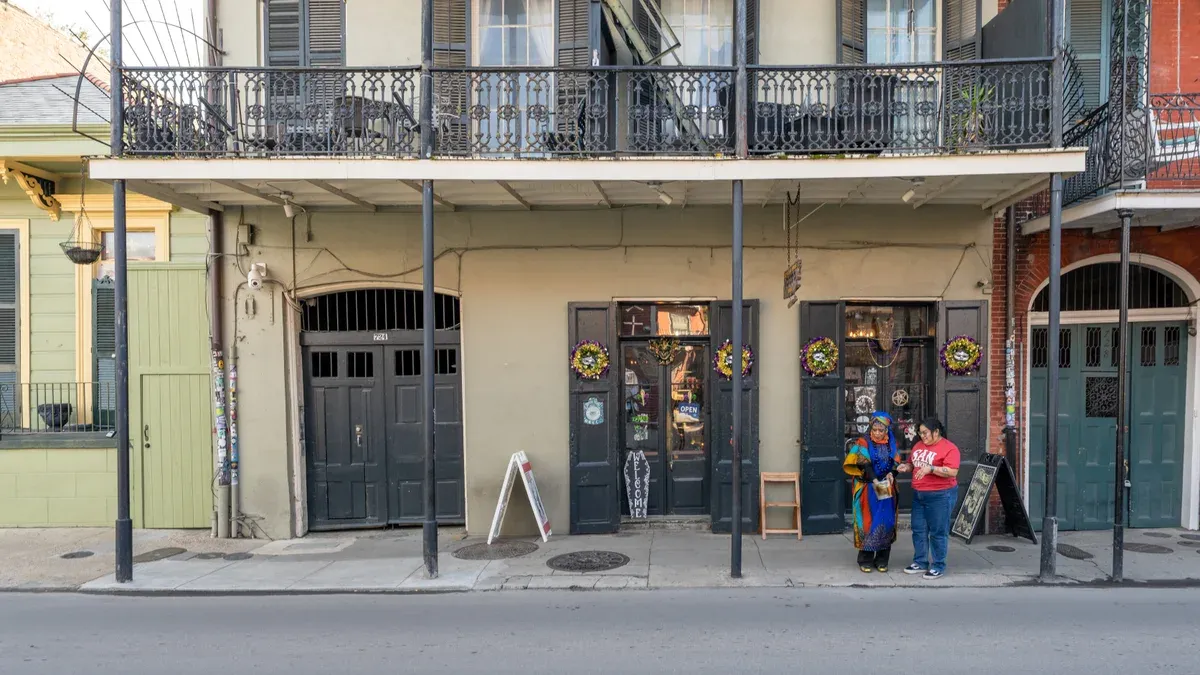
The New Orleans Historic Voodoo Museum at 724 Dumaine Street. Photo: ajay_suresh, CC BY 4.0, via Wikimedia Commons
How to See Marie Laveau's Tomb
You cannot walk up to the tomb on your own. Since 2015 the only way in is with a guide, and the easiest option is the official walk that starts across the street.
Guided Access Only Since 2015
Since 1 March 2015 entry to St. Louis Cemetery No. 1 is limited to relatives of the dead, scholars and visitors with a guide registered with the Archdiocese. Registered guides must show insurance and hold a city license. Occasional guides pay $40 for a one-time pass and regular tour companies pay $4,500 to $5,400 a year for access.
There is no walk-in visiting, so a tour booking is the price of admission, in a literal sense.
The Official Walk at $25
The St. Louis Cemetery No. 1 Official Walking Tour costs $25 and lasts 55 minutes, with groups capped at 20 people and a locally licensed guide. It meets at the Cemetery Tours Desk inside the Basin St. Station Visitor Information Center at 501 Basin Street, directly across from the cemetery, and you should check in 15 minutes early to receive your Cemetery Tour Access Pass. The route passes the tombs of Marie Laveau and Homer Plessy.
Infants two and under join free, the route is wheelchair accessible with uneven surfaces, and only ADA service animals are allowed. Tours run rain or shine, day departures are listed every 15 minutes from 9 a.m. to 4:30 p.m. with after-dark tours on select nights, and the times show when you check availability. Personal photos are allowed, professional filming needs prior written permission from the Archdiocese.
Save Our Cemeteries runs a comparable tour at $25 for adults with children under 12 free, leaving from Backatown Coffee Parlour at 301 Basin Street. For the cemetery's wider history and other graves, see St. Louis Cemetery No. 1.
What Not to Do at the Tomb
The rules are the Archdiocese's, and the guide enforces them. No touching, sitting or leaning on tombs. No food inside, though lidded bottled water is allowed.
No rubbing, marking or leaving items on tombs, which includes the three-X ritual that gave the tomb its folk reputation. Tickets are valid for the scheduled departure time only.
- Do not draw X marks or leave offerings, because the Archdiocese calls it vandalism
- Do not bring food, because it is not allowed inside
- Do not touch or lean on the tomb, because the rules on the official tour forbid it
- Do photograph for yourself, because personal photos are allowed on the tour
Sources: NPR, neworleans.com, Save Our Cemeteries
Marie Laveau's New Orleans
Laveau's city survives in fragments. A house site on St. Ann Street, a Voodoo museum on Dumaine, a square in Tremé, and tour routes that retell her story.
The House Site at 1020 St. Ann Street
Laveau died at her home on St. Ann Street, and ghost lore places her cottage at 1020 St. Ann Street between Rampart and Burgundy, saying her spirit still holds ceremonies there. The cottage itself was built about 1798 by her grandmother Catherine Henry. After Glapion's death the property was seized for debt, and Laveau stayed on through a friend who bought it.
By the 1830s she led a multiracial religious community and held weekly ceremonies at this home.
The Voodoo Museum and the Voodoo Shops
The New Orleans Historic Voodoo Museum at 724 Dumaine Street opened in 1972. Admission is $10 for adults and $8 for seniors, military and students, and it is open Monday to Thursday 10 AM to 6 PM and Friday to Sunday 10 AM to 7 PM. Its own Voodoo walking tour costs $36, lasts about 2 hours and passes Congo Square and Marie Laveau's house.
On Bourbon Street, Marie Laveau's House of Voodoo operates as a shop and small museum selling spiritual items, charms and herbs and offering readings.
Congo Square
Congo Square sits inside Louis Armstrong Park in Tremé and covers 2.7 acres. A mayor's ordinance in 1817 confined gatherings of enslaved Africans to this square, and visitors recorded 500 to 600 people dancing and drumming there on Sundays. The square joined the National Register of Historic Places in 1993, and the Congo Square Preservation Society holds a drum circle there every Sunday.
Which Tours Tell Her Story
Not every ghost walk names Laveau. This table compares the tours whose route or description mentions Voodoo, alongside the official cemetery walk that passes her tomb. Prices come from the listings, and the times show when you check availability.
| Tour | Price | Length | Voodoo in the route |
|---|---|---|---|
| New Orleans Haunted Ghost, Voodoo and Vampire French Quarter Walking Tour | $33 | 1.5 - 2 hours | Passes the New Orleans Historic Voodoo Museum |
| New Orleans Ghost, Crime, Voodoo and Vampires Guided Tour | $37 | 1.5 - 2 hours | Voodoo is in the title and description, with a stop near Armstrong Park |
| St. Louis Cemetery No. 1 Official Walking Tour | $25 | 55 minutes | Passes the tomb of Marie Laveau |
| Voodoo walking tour of the Voodoo Museum | $36 | About 2 hours | Passes Congo Square and Marie Laveau's house |
Sources: Voodoo Museum, 64 Parishes, HNOC
Frequently Asked Questions
Where is Marie Laveau actually buried?
She is generally believed buried in plot 347, the middle vault of the Glapion family tomb in St. Louis Cemetery No. 1, though the Archdiocese records do not list her there and a disputed claim puts her in St. Louis Cemetery No. 2.
Can you visit Marie Laveau's tomb?
Yes, but only on a guided tour, since 1 March 2015 the cemetery is closed to unaccompanied visitors. The St. Louis Cemetery No. 1 Official Walking Tour costs $25, lasts 55 minutes and passes her tomb.
Why do people draw XXX on Marie Laveau's tomb?
The belief says you draw three X marks, turn three times, knock and call out a wish. The Archdiocese now calls the marks vandalism and forbids them on the official tour.
What did Marie Laveau look like?
No verified contemporary portrait or photograph of her exists, and paintings attributed to her are unidentified portraits of free women of color. Newspapers at her death described a woman of great beauty, intellect and charisma.
What are some famous tombs in New Orleans?
In St. Louis Cemetery No. 1 alone you find the Laveau tomb, Homer Plessy's tomb, the nine-foot Nicolas Cage pyramid and the Varney family pyramid. The St. Louis Cemetery No. 1 guide covers them all.
What is the story of Marie Laveau?
Born 10 September 1801, she worked as a hairdresser, herbalist, midwife and Voodoo practitioner, led ceremonies at her St. Ann Street home and drew about 12,000 people to a Lake Pontchartrain ritual in 1874.